

Office space is expensive. Well, it was a bargain like 5 years ago. And your guess is right. Pandemic years.
Now a square meter of space in high-end towers like in Ayala Triangle would run from PHP 1,700 – 2,400+ per sqm per month. Some Grade A offices, standard corporate spaces would be PHP 1,000 – 1,700 and the more affordable basic offices, they call them Grade B offices would cost PHP 800 -1,000 per sqm per month.
Quite expensive now and it all depends on the building’s grade and location within the city. Also, rates vary due to demand in Metro Manila’s prime market.
All the reason, you’d have to plan well when setting up an office.
But that’s not the only reason to plan well with your office set-up. The planning should look first at your people. The office layout decides how your team performs every day.
Let me share a quick story.
A Quezon City business owner told me: “We think we need better employees.”
They had 30 people in a tight office. Sales calls beside developers. Meetings are happening at cramped conference tables. You guess, right. Noise. No quiet space at all.
We rearranged the whole office. Yes, we removed the bulky carpentered wooden dividers, replace them with our office cubicles, retro office tables, crippled revolving office chairs, and a lot of extraneous office furnishings that have nothing to do with their call-center BPO business.
We redesigned the whole office layout. Added 2 phone booths, created a quiet zone, and grouped teams properly.
Before the set-up we usually ask about the workflow. How documents are handled from what group to another group. The location of the people handling customers, the people who are always going in and out (in a tight room, you are always getting elbowed). And other processes
Eight weeks later, the owner, when I followed up his balance (haha), said: “Output doubled. Same team.”
That’s not HR. No loud voices. Pure office layout.
Why most office layouts in the Philippines fail
Now why do many offices fail? I have observed a recurring pattern. Office furniture are not in their ideal places. They have rows of office tables, like in grade school. One big meeting room – when most of the time only 3 or 4 people meet once or twice a week. Then there is the kitchen in a corner with the water dispenser, coffee machine, etc.
It looks efficient. But it creates problems: Noise builds up fast, people can’t focus, teams stop collaborating.
The fix is simple and proven. We have done it in many offices. They call it ABW. This was made popular by Dutch consultant Erik Veldhoen in his book The Demise of the Office.
Activity-Based Working (ABW)
Instead of one desk for everything, you create zones. Here are some I have identified:
- Focus zones – quiet work
- Collaboration zones – team discussions
- Social zones – pantry, break areas
- Privacy zones – calls and meetings
This is now standard in modern office fit-outs in the Philippines. And it works. Why? Because people choose the right space for the task.
Office layout for 20 employees (Philippines)
-
BPO / Call Centers (high-density)
Recommended size: 60–90 sqm
- 3.0 – 4.5 sqm per person
- Very tight layouts
- Small workstations (often 1.0–1.2m wide)
- Designed for maximum headcount
This is the most space-efficient setup and very common in Quezon City, Ortigas, and Cebu IT parks.
-
Corporate Offices (standard density)
Recommended size: 100–160 sqm
- 5.0 – 8.0 sqm per person
- Mix of office cubicles, meeting rooms, and cabinets
- More spacious than BPOs
This is the “normal” range for most Philippine companies.
-
Premium / Executive Offices (low density)
Recommended size: 160–240 sqm
- 8.0 – 12 sqm per person
- Larger desks, executive chair, wider aisles (120cm at least), more collaboration areas
- Includes lounges, breakout zones, etc.
This is common in multinational HQs or high-end firms.
Now that’s the range, but for quick calculations, you can just have my rule of thumb. Here it is:
- Tight / cost-efficient: 4 sqm/person
- Balanced / typical: 6 sqm/person
- Spacious / premium: 10 sqm/person
Office layout for 50 and 100 employees (Philippines)
Recommended size: Use my rule of thumb guide
Now 100 is quite a number now, you may need a help with an office expert here. But here are some pointers:
Layout Strategy
Your layout strategy depends on what kind of business you are in. A BPO would be different from a corporate office layout. There are also times when you would opt for a mixed layout or a hybrid arrangement.
Now here are some things you might consider in you strategy:
BPO Layout (density is 4 sqm/person)
Space Allocation
- 70–80% Workstations
- 5–10% Meeting rooms
- 5% Breakout
- 10–15% Support (pantry, lockers, IT)
Layout Style
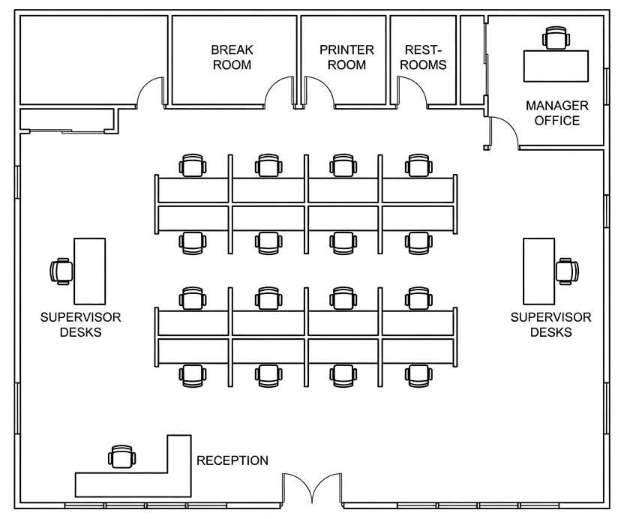
- Grid-based rows (like a command center)
- Minimal dead space
- Straight circulation paths (fast supervision + easy cabling)
Workstation Specs
- 1000–1200 mm width per seat
- Shared long benches
- Low partitions or none
Good For
- Voice accounts / high headcount operations
- 24/7 shifting teams
- Cost per seat is priority
Corporate Layout (density is 6 sqm/person)
Space Allocation
- 50–60% Workstations
- 15–20% Meeting rooms
- 10–15% Collaboration zones
- 10–15% Support spaces
Layout Style
- Zoning strategy:
- Focus zone (quiet work)
- Collaboration zone
- Meeting zone
- Movement is fluid, not rigid
Workstation Specs
- 1200–1400 mm per person
- Clustered pods (4–6 people)
Good for
- Admin, finance, marketing, management
- Companies valuing productivity and comfort
- Day shift operations
Hybrid Layout (density is 5 sqm/person)
Space Allocation
- 30–40% Assigned desks
- 20–30% Hot desks
- 20% Collaboration areas
- 10–15% Meeting rooms, Conference Tables
- 5–10% Focus rooms / phone booths
Layout Style
- Activity-Based Working (ABW)
- Deep work -quiet pod
- Teamwork – open table
Workstation Specs
- Share desks or open seating
- Lounge seating
- Touchdown counters
- Lounge seating
- Touchdown counters
Good for
- Tech companies, startups, creatives
- Hybrid/Work From Home Teams
- Companies optimizing both cost and experience
Most Companies when planning for offices or are expanding into bigger offices are looking for growth in their business in a couple of years, so planning for a bigger space should also be allocated. Growth is expensive if your office isn’t ready. Now here’s my +1 rule:
Plan for growth (The +1 Rule)
- 20 employees → design for 30
- 50 employees → prepare for 75
- 100 employees → plan for 120
Think of your office not just a workspace. It’s a performance system. When designed right, people focus better, your teams move faster.